Ducati India
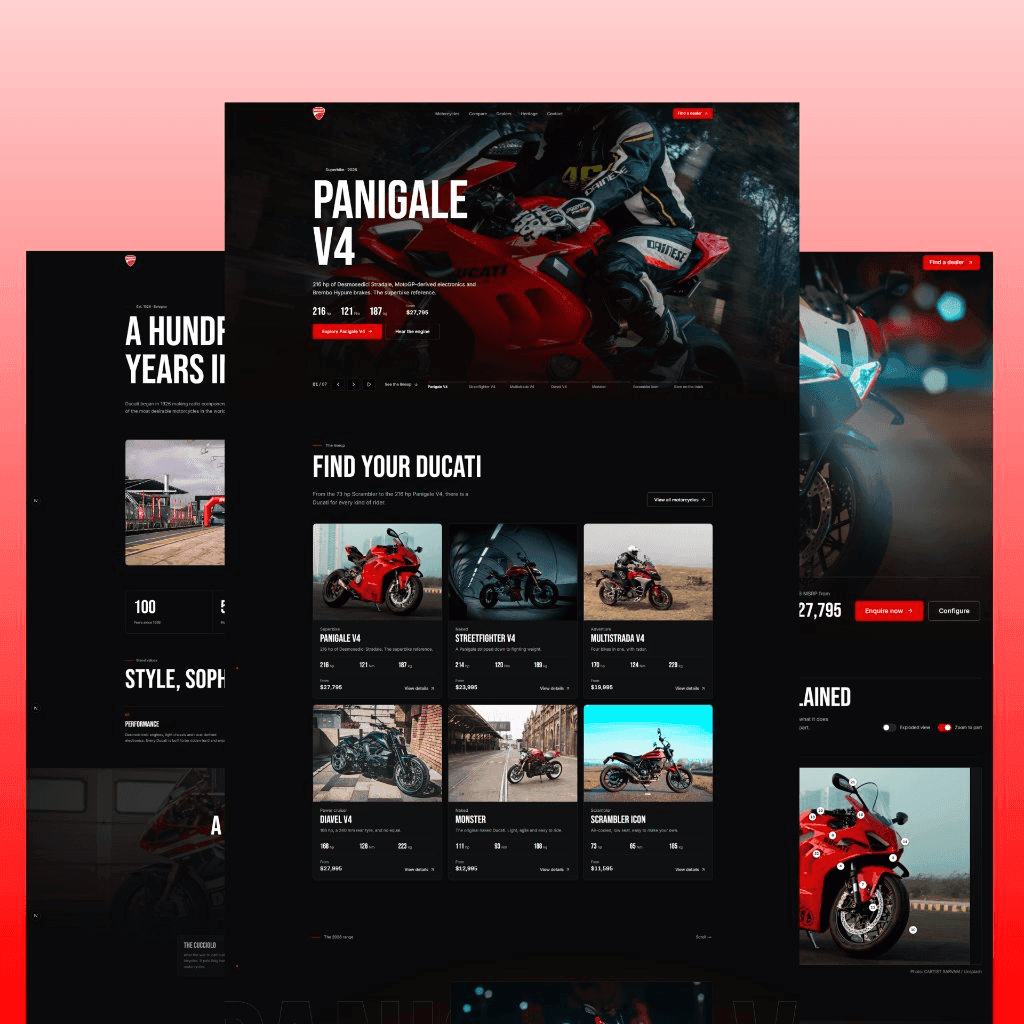
A cinematic digital platform for Ducati India featuring procedural Web Audio engine acoustics, an interactive physical key ignition with spring damping, a 6-speed ride simulator with model-accurate SVG TFT instrumentation, an anatomy hotspot studio, financial EMI calculator, and zero-dependency PDF brochure generation.
LiveIndependent2026
Next.js 16 · React 19 · TypeScript · Web Audio API · Motion · GSAP · Lenis · Tailwind CSS 4 · Zustand
Overview
- What it is
- A cinematic luxury motorcycle platform showcasing the full Ducati range in India (Panigale V4, Streetfighter V4, Multistrada V4, Diavel V4, Monster, Scrambler Icon) with procedural engine acoustics, an interactive physical key ignition, a 6-speed virtual ride simulator, interactive anatomy hotspots, 360° photo views, and dealer geolocation.
- Why it exists
- Traditional automotive websites rely on heavy, battery-draining WebGL 3D models or static image galleries with looped audio clips that fail to convey the visceral feel of a superbike. This project re-engineers digital automotive presentation into a lightweight, photo-realistic, procedural acoustic experience that runs at 60 fps on any device.
- The problem
- Real-time procedural engine audio synthesis with exact cylinder firing orders (V4 Twin Pulse and 90° L-twin) must run concurrently with 60 fps tachometer and speedometer telemetry without causing React render stalls, high audio latency, or massive bundle sizes.
- Who uses it
- Superbike enthusiasts, motorcycle buyers across India, and automotive digital designers.
Given / Find
Given
- a)A full catalog of 6 Ducati motorcycle models with detailed engineering specs and multi-angle studio photography
- b)The requirement for procedural acoustics that faithfully simulate the Desmosedici Stradale V4 and Testastretta 11° L-twin firing sequences
- c)Interactive studio features: physical key drag ignition, starter motor cranking, 6-speed quickshifter gearbox, and anatomy hotspots
- d)Utility features: dynamic PDF brochure generation without heavy headless browsers, financial EMI calculator, 3-bike comparison, and dealer geolocation
Find
- a)A pure Web Audio API synthesizer modeling the acoustic pulse train of each cylinder firing cycle without loading repetitive audio files
- b)Zero-rerender telemetry using Motion values and direct DOM updates to keep React component trees idle while needles sweep at 60 fps
- c)A zero-dependency binary PDF generator producing formatted A4 specification brochures directly from Next.js route handlers
- d)An interactive physical key ignition barrel with spring-damped snapping across OFF, ON, and START detent positions
- e)An HSV color-space recoloring algorithm to produce realistic paint variants (Dark Stealth, Aviator Grey, Iceberg White, Thrilling Black, 62 Yellow) while preserving specular gloss highlights and hotspot coordinates
Approach
Built with Next.js 16 App Router and React 19. An audio engine synthesizes exhaust sound via PeriodicWave harmonic trains (80 harmonics) calculated from crank angle firing degrees (Twin Pulse 0°, 90°, 290°, 380°), augmented by intake roar, quickshifter ignition cuts, overrun crackles, and an algorithmic garage impulse response reverb. A physical key drag-and-drop mechanism (motion/react useSpring) interfaces with a virtual key ignition state machine to drive a 6-speed ride simulation with gear-ratio acceleration curves. Model-specific TFT SVG displays render live tachometer arcs and warning lights. Real turntable photography is parsed directly from binary headers without external image libraries.
My role
Lead Full-Stack & Creative Engineer · Complete architecture & implementation
- Audio EngineeringOwnedCreated the procedural Web Audio API synthesizer: V4 Twin Pulse and L-twin pulse waves, load-dependent filtering, quickshifter cuts, auto-blipped downshifts, and algorithmic impulse reverb.
- Frontend & Motion ArchitectureOwnedConstructed the Next.js 16 App Router interface: model-accurate SVG TFT clusters (Track/Road layouts), spring-damped physical key ignition, 6-speed ride physics, GSAP pinned showcase, and Lenis smooth scroll ticker sync.
- Data & System UtilitiesOwnedBuilt the zero-dependency PDF generator, binary image header parser for 360° spins, financial EMI calculator, HSV paint recoloring script, and dealer network locator with geolocation.
Stack
- Frontend
- Next.js 16 App RouterReact 19TypeScriptTailwind CSS 4Motion (motion 14)GSAP 3 + ScrollTriggerLenis Smooth ScrollRadix UIZustand 5
- Third-party services
- Web Audio API (Procedural Synthesis)SVG Gauge Cluster EngineHTML5 Geolocation APIZero-dependency PDF Engine
- Database
- TypeScript Typed Data LayerZod validationBinary image header parsing
- Infrastructure
- Vercel / Cloudflare DNSStrict SSL / TLSTurbopack
Key features
F.01
Procedural Web Audio Engine
Real-time acoustic synthesis generating authentic Desmosedici Stradale V4 (Twin Pulse 0°, 90°, 290°, 380°) and 90° L-twin exhaust notes with load-dependent saturation, intake roar, and overrun crackles.
F.02
Physical Key Ignition & Spring-Damped Barrel Snap
Spring-damped key drag (motion/react useSpring) into the ignition barrel across 3 detent positions (OFF 0° → ON 60° → START 100° spring return), keyboard accessible (Enter / Arrow keys), with starter motor cranking audio.
F.03
Virtual 6-Speed Ride Simulator
60fps telemetry decoupled from React state into motionValue streams with model-specific gear ratios, neutral throttle revving, and rev-limiter bounces.
F.04
Model-Specific Digital TFT Displays
Custom SVG replicas of real Ducati instrument clusters: Panigale 6.9" Track/Road with DTC/EBC/ABS rider aids grid, Multistrada 6.5" navy visor display, Diavel 5" trapezoid, Monster 4.3" compact, and Scrambler 4.3" round dial.
F.05
Financial EMI & On-Road Calculator
Comprehensive bike finance computation with dynamic down payment slider, loan tenure selection (12 to 60 months), interest rate simulation, and detailed on-road price breakdown.
F.06
Anatomy Hotspot Studio & Part Drawer
Interactive component explorer mapped to high-resolution studio photography with percentage-based hotspot coordinates, part sheet drawers, and close-up focus transitions.
F.07
360° Photo Turntable Viewer
Hardware-accelerated 360° viewer reading photo sets from disk with automated binary image header parsing, touch/drag with momentum, zoom, and fullscreen inspection.
F.08
Dynamic Spec Brochure PDF Generator
Custom zero-dependency binary PDF writer generating downloadable A4 technical spec sheets with typography, headers, and specification tables directly from route handlers.
F.09
3-Bike Comparison Matrix
Interactive comparison tool with URL synchronization (/compare?bikes=...), category-best metric highlighting, and comprehensive specification breakdown.
F.10
Dealer Network & Geolocation
Interactive dealer locator across major Indian cities with service filters (Sales, Service, Customization, Track Academy), search, and HTML5 "Near Me" Haversine distance calculations.
Architecture
Browser Client · Next.js 16 App Router
Motion (motion 14) · GSAP ScrollTrigger · Lenis Smooth Scroll · Radix UI · Tailwind CSS 4
Real-time Telemetry & Procedural Audio NodesAudio & Telemetry Simulation Core
Web Audio API Synthesizer (PeriodicWave, Twin Pulse V4 & L-twin firing sequences) · useEngineStore · 60fps Motion Values
3-Tier Service & Binary PipelineService & Generator Layer
Zero-dependency PDF Spec Brochure Route Handler · Binary Image Header Parser (360° spin) · bikeServiceApi · dealerServiceApi
Called by the API
Unsplash CDN
Automated HSV paint recolor pipeline & responsive delivery
HTML5 Geolocation
Haversine distance calculation for Indian dealer network
Challenges
Problem 01
Given
Pre-recorded exhaust audio samples feel repetitive, have noticeable seams when looping, and require tens of megabytes of bandwidth.
Approach
Constructed a real-time procedural synthesizer in Web Audio API driven by engine stroke physics (crankshaft degrees, cylinder count, intake resonance, and exhaust backpressure).
Result
Immediate, lag-free acoustic feedback responding dynamically to RPM changes with zero audio asset bandwidth overhead.Problem 02
Given
Updating React state at 60fps for tachometers, speedometers, and gear indicators causes high CPU usage and frame drops.
Approach
Decoupled telemetry into motionValue streams that update DOM attributes directly, keeping React component trees completely static during revving.
Result
Rock-solid 60fps telemetry rendering on both mobile and desktop screens.Problem 03
Given
Generating downloadable PDF brochures on serverless edges usually requires heavy headless browser dependencies.
Approach
Implemented a pure, zero-dependency PDF writer directly encoding WinAnsi typographic streams and A4 coordinate matrices in TypeScript.
Result
Instantaneous, lightweight spec brochure generation with zero serverless bundle bloat.
Results
Outcome
What I learned
- Web Audio API procedural sound synthesis can completely replace bulky audio samples for interactive automotive web experiences.
- Decoupling high-frequency telemetry from React state via Motion values is essential for 60fps animations.