SkillSync LMS
A course platform where admins moderate, instructors publish and get paid, and students learn, pay and earn certificates anyone can verify.
LiveAcademic team project2026
Next.js 16 · NestJS 10 · Prisma 7 · PostgreSQL · Stripe · Socket.IO
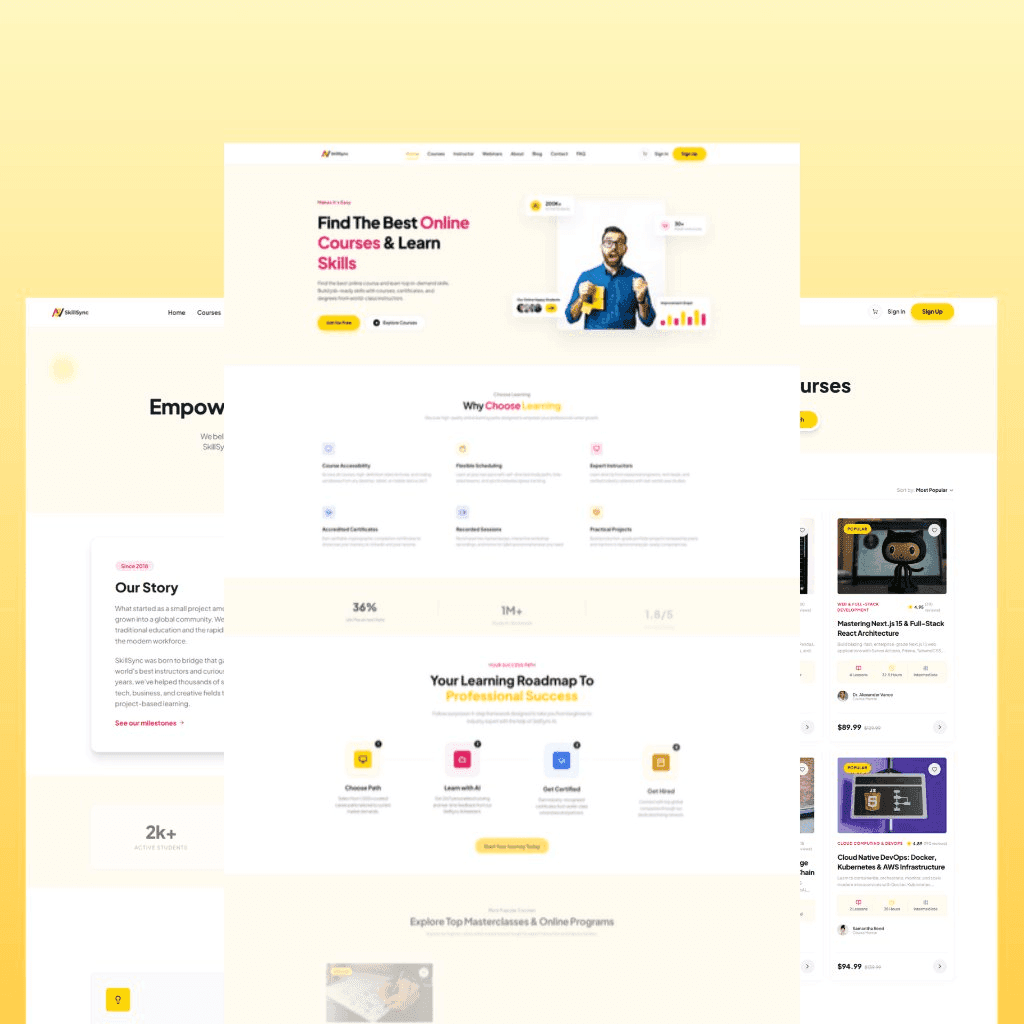
Overview
- What it is
- A three-role learning management system: admin, instructor and student, each with its own dashboard.
- Why it exists
- It began as an academic team brief for an online course management system and was extended into a complete product, packaged for marketplace review.
- The problem
- Course platforms need payments, permissions, real-time communication and trustworthy certificates working together, not as separate demos.
- Who uses it
- Admins who moderate content, instructors who publish and earn, and students who learn and need proof of completion.
Given / Find
Given
- a)An academic brief for an online course management system
- b)Three roles with different permissions: admin, instructor, student
- c)Paid courses, live communication and certificates outsiders can trust
Find
- a)One platform where admins moderate, instructors publish and earn, and students learn and pay
- b)Certificates anyone can check from a public verification page
- c)Security that holds up outside a classroom demo: 2FA, rate limits, validated uploads
Approach
A modular NestJS application (19 feature modules) with Prisma schemas split by domain; JWT with refresh cookies and TOTP two-factor sign-in; Socket.IO gateways for chat and notifications; Stripe checkout confirmed by webhook; PDF certificates checked at /verify/[code]; uploads validated by magic bytes.
My role
Full-stack developer · every commit in both repositories
- FrontendOwnedAbout 110 Next.js 16 pages across the three role dashboards and the public site.
- BackendOwned19 NestJS feature modules, guards, gateways and the payment and certificate flows.
- Data modelOwned17 Prisma schema files split by domain over PostgreSQL.
Stack
- Frontend
- Next.js 16 App RouterReactZustandTanStack QuerySocket.IO clientTailwind CSS
- Backend
- NestJS 10Socket.IO gatewaysNodemailer
- Database
- PostgreSQLPrisma 7 over a pg poolOptional read-replica client
- Auth & security
- JWT + HttpOnly refresh cookiesTOTP two-factorRole guardsCSRF origin checks
- Third-party services
- Stripe checkout + webhooksCloudinarySMTP
- Infrastructure
- Redis rate limitingDocker ComposeCoolify · VPS PaaS
Key features
F.01
Three role dashboards
Admins moderate courses and users, instructors publish lessons and follow their earnings, and students track progress across enrolled courses.
F.02
Payments confirmed by webhook
Stripe Checkout takes the payment; enrollment is granted only when Stripe’s signed webhook confirms it, not when the browser says so.
F.03
Certificates anyone can verify
Completing a course issues a PDF certificate with a code. Anyone can check the code on a public /verify page.
F.04
Real-time chat and notifications
Socket.IO gateways deliver chat messages and notifications without polling.
F.05
Protected lessons and accounts
TOTP two-factor sign-in, signed playback tokens for lesson video, and AES-256-GCM encryption for sensitive fields.
F.06
Uploads checked by content
Files are validated by their magic bytes, the actual signature inside the file, before anything reaches Cloudinary.
Architecture
Browser · Next.js 16 App Router
Zustand stores · TanStack Query · Socket.IO client
REST (JSON + HttpOnly cookies) · WebSocketNestJS 10 · one modular application
Guards: JWT · roles · throttling · CSRF origin19 feature modulesgateways: chat, notifications
Prisma 7 over a pg pool · optional read clientPostgreSQL
17 schema files by domain
Called by the API
Stripe
checkout + webhook confirmation
Cloudinary
course media uploads
SMTP · Nodemailer
verification and notices
Redis
rate limits; memory fallback if Redis is down
Challenges
Problem 01
Given
Rate limiting depends on Redis, but a Redis outage should not take the API down with it.
Approach
Throttling uses Redis when it is reachable and falls back to an in-memory store when it is not.
Result
Limits keep working through a cache outage, and the API stays up.Problem 02
Given
Read-heavy pages such as catalogues and dashboards compete with writes on one database.
Approach
Prisma runs with an optional read-replica client that serves reads and falls back to the primary when no replica is configured.
Result
Reads can move to a replica through configuration alone, with no code change.Problem 03
Given
A renamed file extension can slip the wrong file type past an upload form.
Approach
An inspector reads each upload’s magic bytes and rejects anything whose signature does not match an allowed type.
Result
Only genuine images, documents and media are stored.
Results
Outcome
What I learned
- Webhooks, not redirects, are the source of truth for payment state.
- Designing the fallback path (Redis down, no replica) is part of the feature, not an afterthought.
- Splitting the schema by domain keeps a large data model reviewable.