Bistro Boss
A full-stack restaurant web application featuring Firebase authentication, interactive category menus, Stripe checkout, automated email receipts, and a Recharts analytics admin dashboard.
LiveLearning project2025
React 19 · Express 5 · MongoDB · Firebase Auth · Stripe · TanStack Query · Tailwind CSS 4
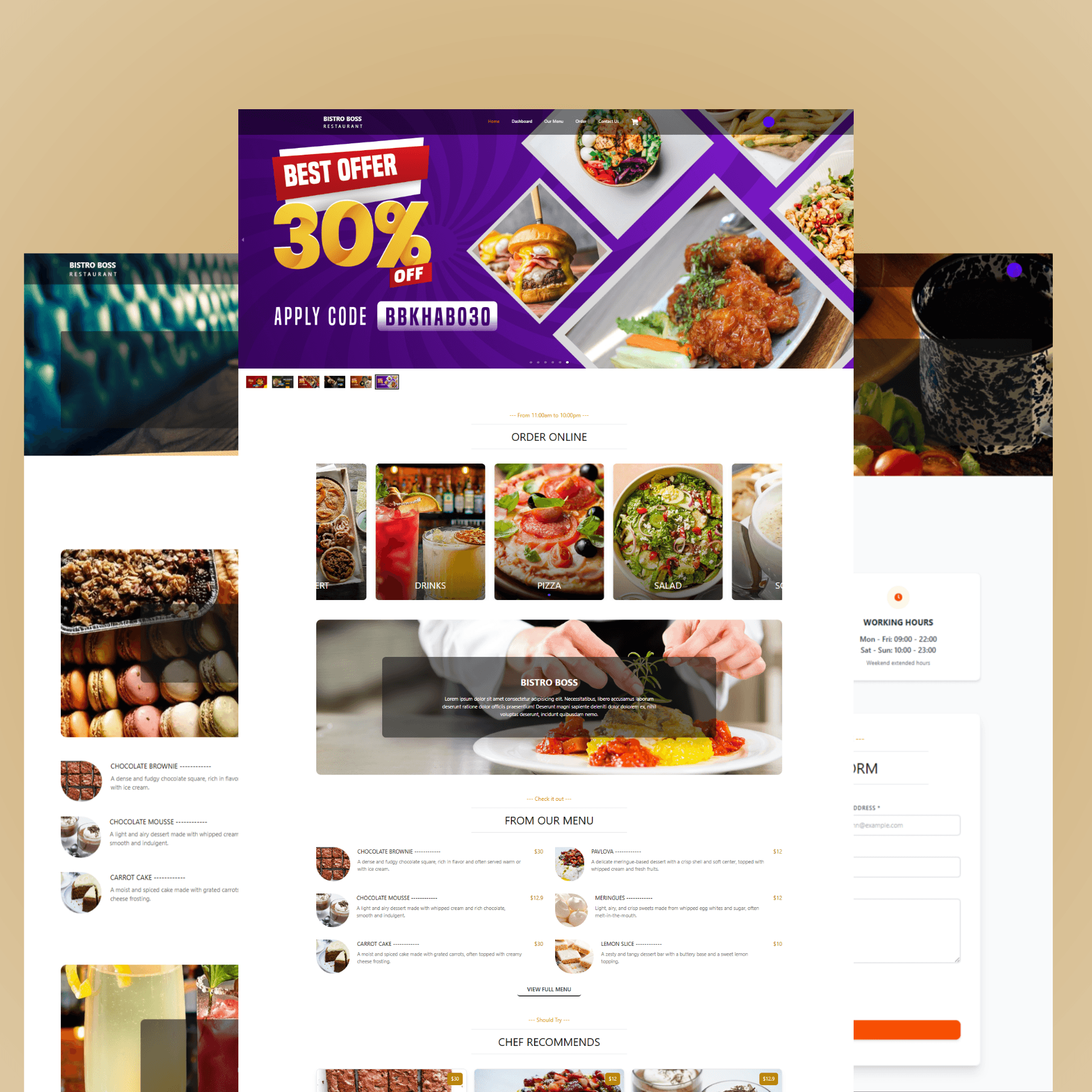
Overview
- What it is
- A complete restaurant ordering, table reservation, and back-office management system.
- Why it exists
- To engineer an end-to-end culinary commerce application handling dynamic category menus, secure multi-role access (Admin vs. Customer), online card transactions, and real-time sales reporting.
- The problem
- Online food ordering demands real-time cart synchronization, secure transactional card processing with immediate receipt delivery, and strict role guards so regular diners cannot access kitchen or revenue dashboards.
- Who uses it
- Diners ordering food online or reserving tables, restaurant managers updating menus, and administrative owners auditing sales.
Given / Find
Given
- a)Multi-category culinary menus (Salad, Pizza, Soup, Dessert, Drinks, Today’s Special)
- b)Customer authentication with Firebase (Email/Password & Google OAuth) backed by MongoDB profiles
- c)Card payments that must securely trigger order persistence and inventory tracking without double billing
- d)Administrative analytics requiring visual charts for sales trends, item demand, and customer counts
Find
- a)A responsive customer cart with optimistic TanStack Query cache updates
- b)A robust two-tier authorization system: Firebase Auth on the client paired with verifyJWT and verifyAdmin on Express
- c)Stripe PaymentIntent flow with server-side validation and automated Nodemailer order receipt dispatch
- d)A Recharts-powered analytics dashboard calculating monthly gross revenue and category-wise sales distribution
Approach
A React 19 single-page application built on Vite and Tailwind CSS v4, communicating with an Express 5 and Mongoose 8 backend. Authentication combines Firebase client SDK with server-side JWT verification and role middleware. Payments run via Stripe Elements and server PaymentIntents, with TanStack Query managing cached menu and cart states.
My role
Full-stack developer · all commits across client and server repositories
- FrontendOwnedArchitected React 19 client with 14 modular routes, TanStack Query hooks, DaisyUI 5, Framer Motion transitions, and Recharts analytics.
- BackendOwnedBuilt Express 5 REST API with verifyJWT and verifyAdmin middlewares, Stripe payment processing, and Nodemailer email dispatch.
- Data modelOwnedDesigned 6 Mongoose models (Cart, Category, Menu, Order, Review, User) with indexing on user email and category keys.
Stack
- Frontend
- React 19Vite 7Tailwind CSS 4DaisyUI 5TanStack Query 5Recharts 3Framer Motion 12React Router 7
- Backend
- Node.jsExpress 5Mongoose 8Firebase Admin SDKJWTNodemailer
- Database
- MongoDB 6+Mongoose schemas (6 collections)
- Auth & security
- Firebase Auth (Google & Email/Password)JWT Bearer token verificationRole guards (Admin / User)
- Third-party services
- Stripe payment gatewayCloudinary CDNGoogle reCAPTCHA v2
- Infrastructure
- Firebase Hosting (Client)Vercel / Render (API)
Key features
F.01
Interactive culinary menu & category filtering
Diners explore specialized food categories (Salads, Pizzas, Soups, Desserts, Beverages) with live price tags, ratings, and ingredient descriptions.
F.02
Stripe card checkout & automated receipts
Seamless credit card checkout using Stripe Elements; successful payments automatically generate database order records and trigger itemized Nodemailer receipts.
F.03
Two-tier role-based security
Client routes and Express endpoints are guarded by JWT tokens and verifyAdmin database checks; unauthorized attempts trigger automatic Axios session invalidation.
F.04
Recharts visual revenue analytics
Visualizes historical sales revenue, order volumes, menu item popularity, and user registration velocity through interactive bar and pie charts.
F.05
Optimistic cart state management
TanStack Query cache synchronization ensures instant cart badge count updates, deletion animations, and total price re-computations without page refreshes.
F.06
User reviews & star rating submissions
Authenticated diners submit verified reviews and star ratings using @smastrom/react-rating, feeding directly into the public testimonial swiper.
Architecture
Browser · React 19 Client
TanStack Query · React Router 7 · Stripe Elements · Recharts
REST API (JSON with Bearer JWT)Express 5 REST API
Middlewares: verifyJWT · verifyAdminRoutes: menu, cart, orders, reviews, users, admin analytics
Mongoose 8 ODMMongoDB
6 collections: users, menu, carts, orders, reviews, categories
Called by the API
Stripe
PaymentIntent processing & card charging
Firebase Auth
user registration & social sign-in
Cloudinary
dish photo uploads via Multer
Nodemailer
automated HTML order invoice delivery
Challenges
Problem 01
Given
Client-side role spoofing could allow malicious actors to invoke administrative endpoints like deleting menu items or viewing revenue.
Approach
Implemented two-phase authorization: the client passes a signed JWT token on every Axios request; the Express server validates the signature and subsequently queries the database to confirm the user’s role equals admin.
Result
Administrative actions are completely locked down on both the frontend navigation guards and the API transport layer.Problem 02
Given
Cart state desynchronization when diners add or remove dishes across multiple browser tabs.
Approach
Utilized TanStack Query query keys with automatic invalidation (invalidateQueries) on cart mutations and Axios interceptors handling unauthorized token expiry.
Result
Real-time cart counts and price calculations stay consistent without full-page reloads.Problem 03
Given
Stripe payment confirmation needs to reliably clear active cart items and create an immutable order history entry.
Approach
Engineered a transactional order creation handler that consumes the Stripe transaction ID, persists the order item details, and deletes the matching cart documents in a single atomic sequence.
Result
Zero duplicate charges or orphaned cart states following checkout.
Results
Outcome
What I learned
- Decoupling authentication (Firebase) from business data access (JWT + Mongoose) provides robust flexibility without vendor lock-in.
- TanStack Query drastically simplifies asynchronous server state and cache synchronization compared to traditional global stores.