DocTime
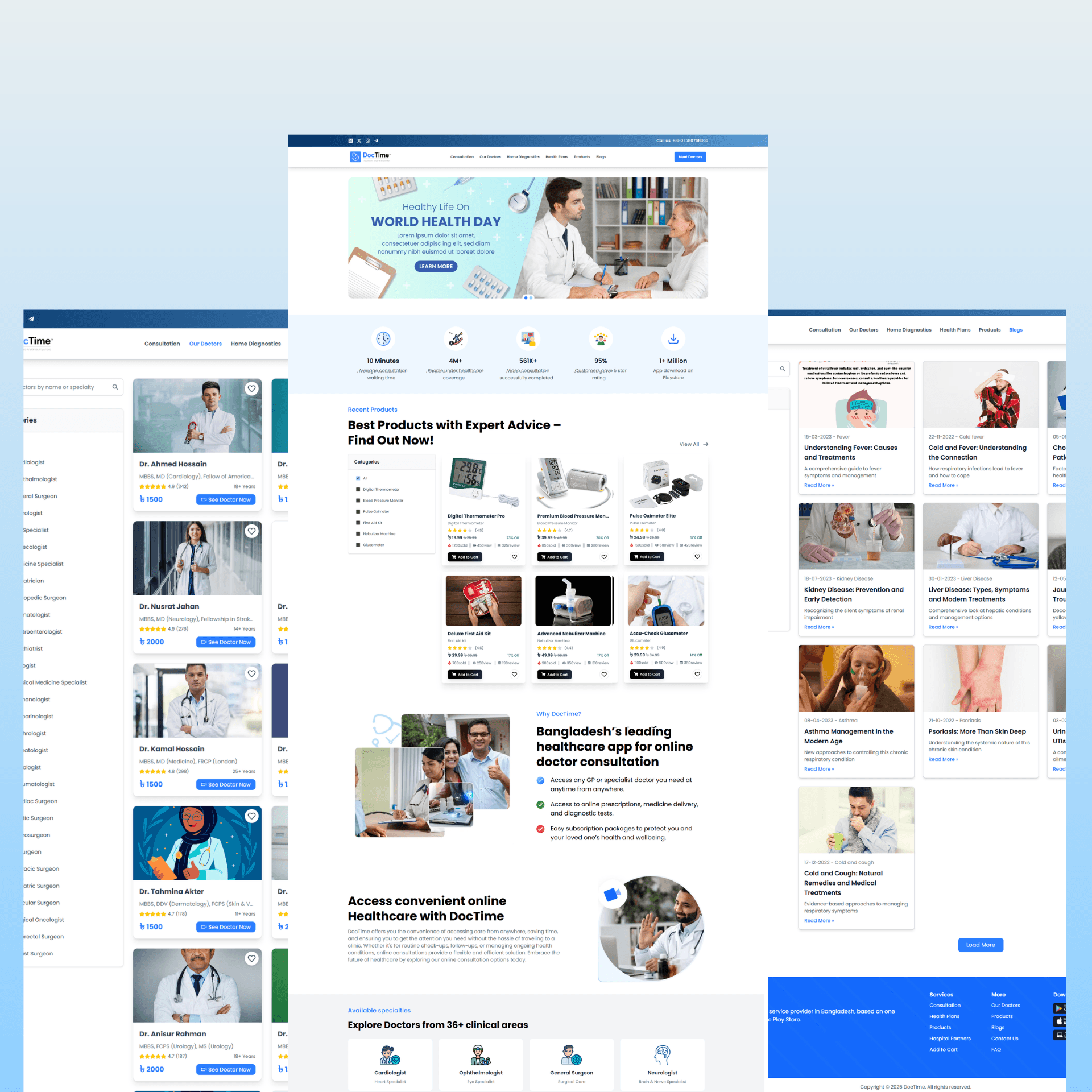
A modern healthcare and telemedicine web portal providing specialist doctor discovery, department-wise symptom filtering, home diagnostics booking, and medical health plans.
LiveIndependent2025
React 19 · Vite 6 · Tailwind CSS 4 · DaisyUI 5 · Framer Motion 12 · React Router 7
Overview
- What it is
- A patient-centric digital healthcare directory, appointment scheduling portal, and home diagnostic services hub.
- Why it exists
- Patients often struggle to find qualified specialists suited to their specific medical symptoms and need a transparent way to compare doctor credentials, consultation fees, and hospital affiliations.
- The problem
- Healthcare websites are typically cluttered, slow, and confusing to navigate under stress. A modern medical portal must offer calming aesthetics, intuitive symptom-to-specialist routing, and responsive mobile appointment scheduling.
- Who uses it
- Patients seeking specialist consultations, families booking home diagnostic lab tests, and healthcare seekers evaluating wellness packages.
Given / Find
Given
- a)Multiple medical departments (Cardiology, Neurology, Pediatrics, Orthopedics, Dermatology, General Surgery)
- b)Comprehensive doctor profiles with degrees, hospital affiliations, consultation fees, and available days
- c)Diagnostic test catalogs and preventive health checkup plans with upfront pricing
- d)Patients browsing from diverse mobile devices during medical urgencies
Find
- a)An instant symptom and department filter allowing patients to locate specialists in under 3 clicks
- b)Clean doctor card layouts highlighting verified credentials, patient review scores, and direct appointment booking buttons
- c)A diagnostic test and wellness package cart system allowing patients to schedule home sample collection
- d)Fluid motion design and accessibility with zero layout shift and rapid page rendering
Approach
A high-performance single-page application built on React 19, Vite 6, and Tailwind CSS v4. Modular component architecture organizes doctor profiles, medical departments, and diagnostic packages. Framer Motion provides comforting, stutter-free scroll transitions, while React Router 7 powers seamless client-side navigation across 12 distinct healthcare views.
My role
Frontend developer & UI architect · 22 git commits
- UI ArchitectureOwnedConstructed 12 responsive healthcare pages including Doctor Directory, Symptom Guide, Diagnostic Cart, Health Plans, and FAQ.
- Component DesignOwnedCreated modular DoctorCard, CartDesign, SymptomTile, and interactive QuestionBox components styled with DaisyUI 5 and Tailwind v4.
- Motion & UXOwnedImplemented Framer Motion scroll animations, tailwind-scrollbar customization, and mobile-optimized touch navigation.
Stack
- Frontend
- React 19Vite 6Tailwind CSS 4DaisyUI 5Framer Motion 12React Router 7tailwind-scrollbar
- Third-party services
- Lucide IconsReact Icons
- Infrastructure
- Netlify CDNVite automated build pipeline
Key features
F.01
Department & symptom-guided specialist matching
Patients click common symptoms (chest pain, migraines, skin rashes) to immediately view matching verified specialists and surgeons.
F.02
Comprehensive doctor credential cards
Displays doctor degrees, designations, clinic affiliations, patient satisfaction ratings, and upfront consultation fees with a 1-click book action.
F.03
Home diagnostic test & wellness cart
Enables patients to add blood tests, health screenings, and annual family wellness plans into an interactive booking cart.
F.04
Interactive medical FAQ accordion
Custom animated accordion answering critical patient inquiries regarding insurance coverage, emergency policies, and report delivery times.
F.05
Responsive emergency contact & appointment triggers
Prominent 24/7 hotline and consultation callout strips engineered for rapid thumb accessibility on mobile screens.
Architecture
Browser Client
React 19 · Vite 6 · Tailwind CSS 4 · DaisyUI 5
React Router 7 client-side navigationHealthcare Module Hierarchy
Doctor Directory · Symptom Filter · Diagnostic Cart · Health Packages · FAQ Accordion
Framer Motion 12 UI pipelineStatic CDN Asset Distribution
High-speed Netlify Edge caching
Challenges
Problem 01
Given
Navigating extensive doctor directories on mobile devices often creates awkward horizontal overflows and sluggish scrolling.
Approach
Engineered a mobile-first responsive grid using Tailwind CSS v4 flexbox and custom tailwind-scrollbar utilities, coupled with lightweight SVG icons.
Result
Consistent 60fps scrolling and effortless thumb navigation across both iOS and Android browsers.Problem 02
Given
Presenting dense clinical details without overwhelming distressed patients with medical jargon.
Approach
Structured doctor cards with clear visual hierarchy: doctor photo and badge at top, bulleted credentials, prominent fees, and high-contrast call-to-action buttons.
Result
Reduced cognitive load and increased user engagement across specialist consultation flows.
Results
Outcome
What I learned
- Healthcare user interfaces require a careful balance of calming color psychology and immediate, unambiguous call-to-actions.
- Vite 6 with React 19 produces near-instantaneous hot module replacement and ultra-compact production bundles.